December 28 , 2025.
Italy / Sicily , Etna :
Etna Activity Report. December 27, 2025, 11:36 (10:36 UTC).
The National Institute of Geophysics and Volcanology, Osservatorio Etneo, reports that over the past 24 hours, eruptive activity at the summit craters of Mount Etna has further intensified. Strombolian activity continued at the Northeast Crater, with almost continuous explosions. During the night, visibility was severely reduced due to dense cloud cover; however, the clouds were constantly illuminated by strong eruptions. Around 09:00 UTC, with partially improved visibility, a rapid increase in the intensity of activity was observed, with lava fountains reaching approximately 150 to 200 meters in height and a continuous emission of ash. At 9:50 a.m., activity at the Northeast Crater decreased again, with sporadic ash emissions. Around 6:00 a.m., images from webcams not affiliated with the INGV showed ash and steam emissions from an area east of the summit, where a lava flow had begun, heading towards the upper Valle del Bove. Thanks to improved visibility, it was possible to observe the opening of a fissure on the upper eastern flank of the Voragine Crater, from which sporadic ash emissions are escaping.
The lava flow appears to originate from this fissure. Persistent cloud cover on Etna’s eastern flank is preventing observation of the extent of this lava flow; an inspection by INGV-OE staff is underway to obtain more detailed information.
Since yesterday morning, December 26, frequent ash emissions have also been occurring from the BN-2 vent of the Bocca Nuova crater.

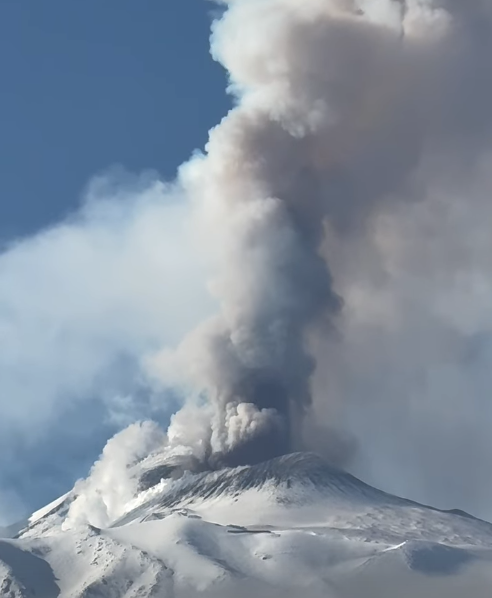
The activity at the summit craters is producing an eruptive column several kilometers high, composed mainly of white steam, which is moving west-southwest. No ashfall has been reported in inhabited areas so far. The average amplitude of volcanic tremor continued the upward trend announced in the previous press release, reaching very high values yesterday around 12:00 UTC.
Although fluctuating, the amplitude of volcanic tremor remained practically stable at this level until about 5:00 UTC this morning, at which time it experienced a sudden increase, peaking around 5:50 UTC, followed by an equally sudden decrease. Around 8:10 UTC, another rapid increase in the amplitude of volcanic tremor was observed, with values, around 8:45 UTC, becoming typical of those associated with lava fountains. Starting at approximately 9:50 UTC, a rapid decrease in the amplitude of the volcanic tremor was observed. The center of gravity of the volcanic tremor sources remains in the Northeast Crater area, specifically slightly northwest of the eruptive vents, at an altitude of approximately 2,700 m above sea level.
Infrasound events continued to occur at a very high frequency, with equally high amplitudes. These events remained primarily localized at the Northeast Crater and, to a lesser extent, at Bocca Nuova. Between approximately 8:40 and 9:50 UTC, another episode of infrasound tremor was observed, with particularly high amplitudes, typical of those associated with lava fountains. Another episode, but with lower amplitudes, was observed this morning between approximately 5:30 and 6:10 UTC.
Analysis of ground deformation data reveals visible deformations on the inclinometer arrays and the DRUV dilatometer. On the latter, a decrease of approximately 110 nanostrains is observed between 8:30 UTC and 9:40 UTC, before the trend reverses. A signal associated with deflation of the crater area is visible on the summit inclinometers; it is also faintly visible on the intermediate-level sensors.
More specifically, two phases of deformation are visible on the ECP summit inclinometer: the first shows a deformation of approximately 5 microradians between 16:30 UTC and approximately 21:00 UTC, and the second variation amounts to approximately 3.5 microradians between 9:00 UTC and 10:00 UTC. No deformation is detectable by the high-frequency GNSS array apart from instrumental noise.
Etna Activity Update. December 27, 2025, 4:28 PM (3:28 PM UTC).
The National Institute of Geophysics and Volcanology, Osservatorio Etneo, reports that after a few hours of relative calm, a new episode of lava fountains began at the Northeast Crater at 2:15 PM UTC. Activity rapidly increased, producing lava jets 300 to 400 meters high and an eruptive column laden with pyroclastic material, which rose several kilometers above the summit of Etna before being pushed westward by the wind. At 2:45 PM, activity began to subside, and the fountains gave way to strong explosions with lava bubbles, ejecting coarse pyroclastic material to the base of the cone and beyond. At the time of this update, intermittent ash emissions continue. Compared to the morning’s fountain episode, this one was more energetic, with higher fountains and a denser eruptive column. Simultaneously,
moderate explosive activity continues from the vent on the eastern flank of Voragine, producing a continuous ash plume several hundred meters high. This activity is ongoing. Cloud cover on the eastern flank obscures the possibility of seeing if the lava flow mentioned in the previous press release is still being fed.
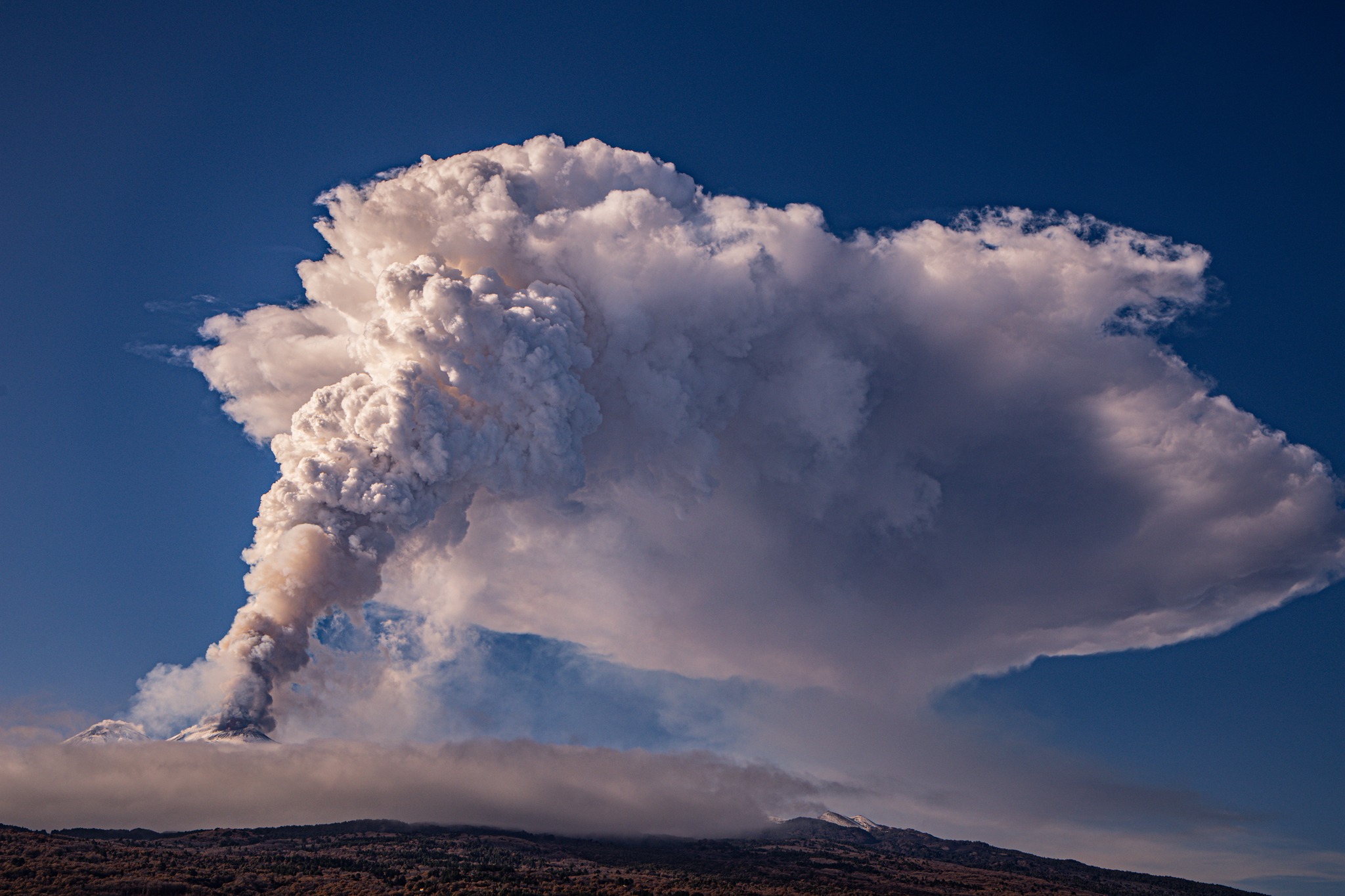
The average amplitude of the volcanic tremor, after the rapid decrease reported in the previous press release, stabilized at high values until approximately 1:40 PM UTC, at which time a new sudden increase in amplitude occurred and rapidly reached values characteristic of lava fountains. From approximately 2:55 PM UTC, a further decrease in amplitude values was observed. The location of the center of gravity of the volcanic tremor sources remains slightly northwest of the Northeast Crater, at an altitude of approximately 2,800 to 3,000 m above sea level. Infrasound events, after a temporary decrease associated with the decrease in volcanic tremor amplitude, from approximately 12:00 PM UTC, returned to very high frequency values, with similarly high associated amplitudes. The events continue to be primarily localized to the Northeast crater and secondarily to Bocca Nuova. Around 14:15 UTC, a new episode of infrasound tremor was observed, with high amplitudes typical of values associated with lava fountains.
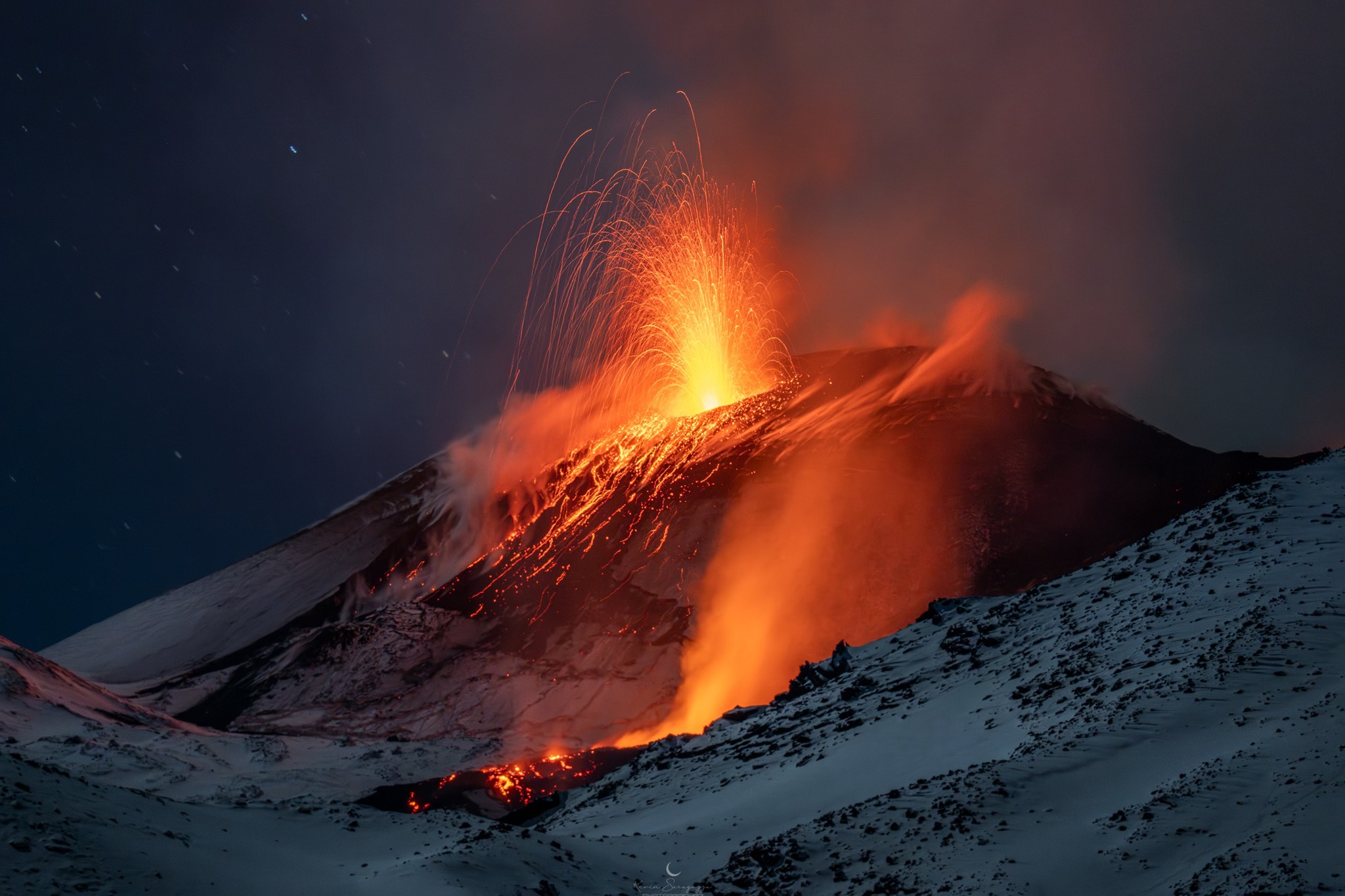
The inclinometer signal shows, after the 3.5 microradian deformation previously recorded by the ECP’s apex sensor, a trend reversal phase that accumulated by approximately 1.5 microradians between 10:00 UTC and approximately 11:00 UTC. This signal remained stable until approximately 14:30 UTC, at which time a new deflation phase appeared to begin, accumulating by approximately 1.5 microradians and appearing to begin decreasing around 15:00 UTC. Following the decompression phase described above, the DRUV dilatometer also showed a trend reversal, accumulating a compression of approximately 80 nano-deformations at a decreasing rate between 9:40 UTC and 14:00 UTC.
From this point, a new decompression began and, up to 15:00 UTC, accumulated approximately 70 nano-deformations. No significant signals are observable on the high-frequency GNSS network.
Etna Activity Update. December 27, 2025, 20:46 (19:46 UTC).
The National Institute of Geophysics and Volcanology, Osservatorio Etneo, reports that with improved visibility, the entire eruptive theater can now be observed.
At 18:48, a series of powerful explosions began at the Northeast Crater, ejecting coarse pyroclastic material across the entire cone and well beyond its base. At the time of writing, sporadic Strombolian explosions, some of them very powerful, are occurring at the Northeast Crater. Meanwhile, activity intensified at the vent on the upper flank of the Voragine crater, which is currently producing a continuous lava fountain several tens of meters high. The lava flow emitted from a vent at the eastern base of Voragine, reported in the 11:36 press release, continues to feed. Satellite images taken this morning indicate that it has traveled approximately 1.8 km eastward, toward Valle del Bove. The average amplitude of volcanic tremor, after the rapid decrease reported in the previous press release, stabilized, albeit at high levels, until approximately 18:45 UTC, at which time a new sudden increase occurred and lasted until approximately 19:15 UTC.
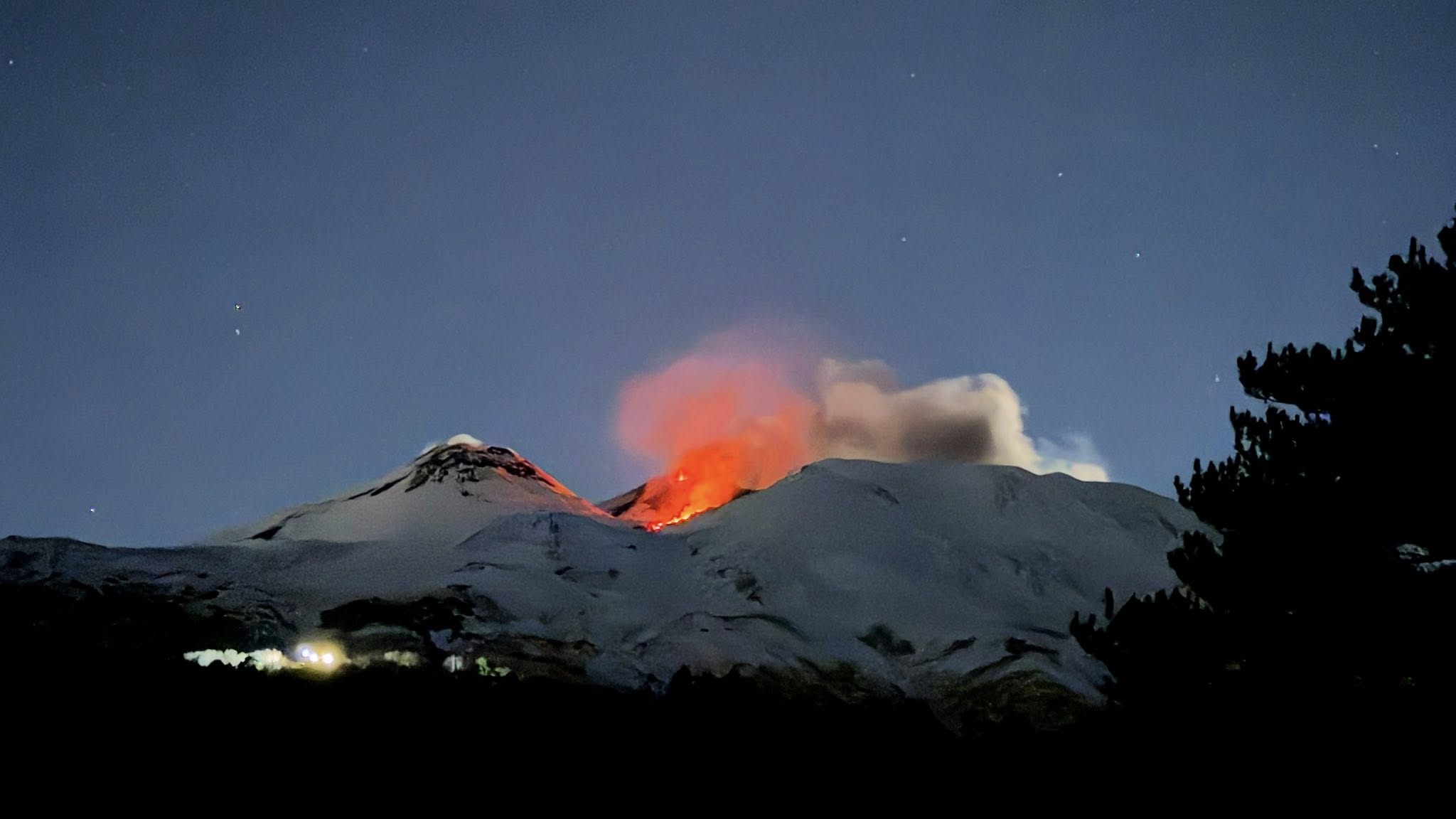
Subsequently, the amplitude returned to values comparable to those observed before this last brief event. The location of the center of gravity of the volcanic tremor sources is currently unavailable due to technical reasons. The last available location at 17:00 UTC indicated that the center of gravity was situated in an area slightly northwest of the Northeast Crater, at an altitude of approximately 2800 to 3000 m above sea level. Infrasound events, after a temporary decrease associated with the reduction in volcanic tremor amplitude, from approximately 18:48 UTC, returned to very high occurrence rates until approximately 18:10 UTC, in some cases with very high amplitudes. The events continue to be primarily located at the Northeast Crater and, to a lesser extent, at Bocca Nuova.
Analysis of ground deformation data reveals no significant changes since the last publication, regardless of the sensor network. The inclinometer network also shows notable stability at the ECP summit inclinometer since approximately 4:30 PM.
The DRUV dilatometer has also been stable since the same time. The high-frequency GNSS network continues to show no variation above background noise.
Further updates will be provided soon.
This old volcano in the Northeast Crater has finally awakened and created several lava fountains—veritable lava fountains—a paroxysm, the first in nearly 28 years. In reality, it could do more: the phenomenon is still evolving, even if, for the moment (December 27, 2025, noon), it seems to have paused.
For many years, it was the only one to rumble slightly at the bottom of the crater; Sometimes, we even observed slightly more intense Strombolian activity at the bottom of the crater, but nothing more. Twice, it seemed on the verge of awakening—on May 18, 2016, and September 12, 2019—but the Voragine eruption triggered, and it gave up.
I liked to say, just to tease it, « The Northeast Crater can’t produce any more paroxysms. » Meanwhile, its little brother, the Southeast Crater, has experienced more than 100 paroxysms in the last 15 years alone. Voragine has also been active, and even Bocca Nuova managed to produce one – unfortunately invisible due to bad weather – on November 10, 2024. Let us therefore briefly revisit the history of this crater, the oldest of the four current summit craters of Etna and which, for more than 40 years, was the highest point of the volcano, before being surpassed in the summer of 2021 by the Southeast crater.
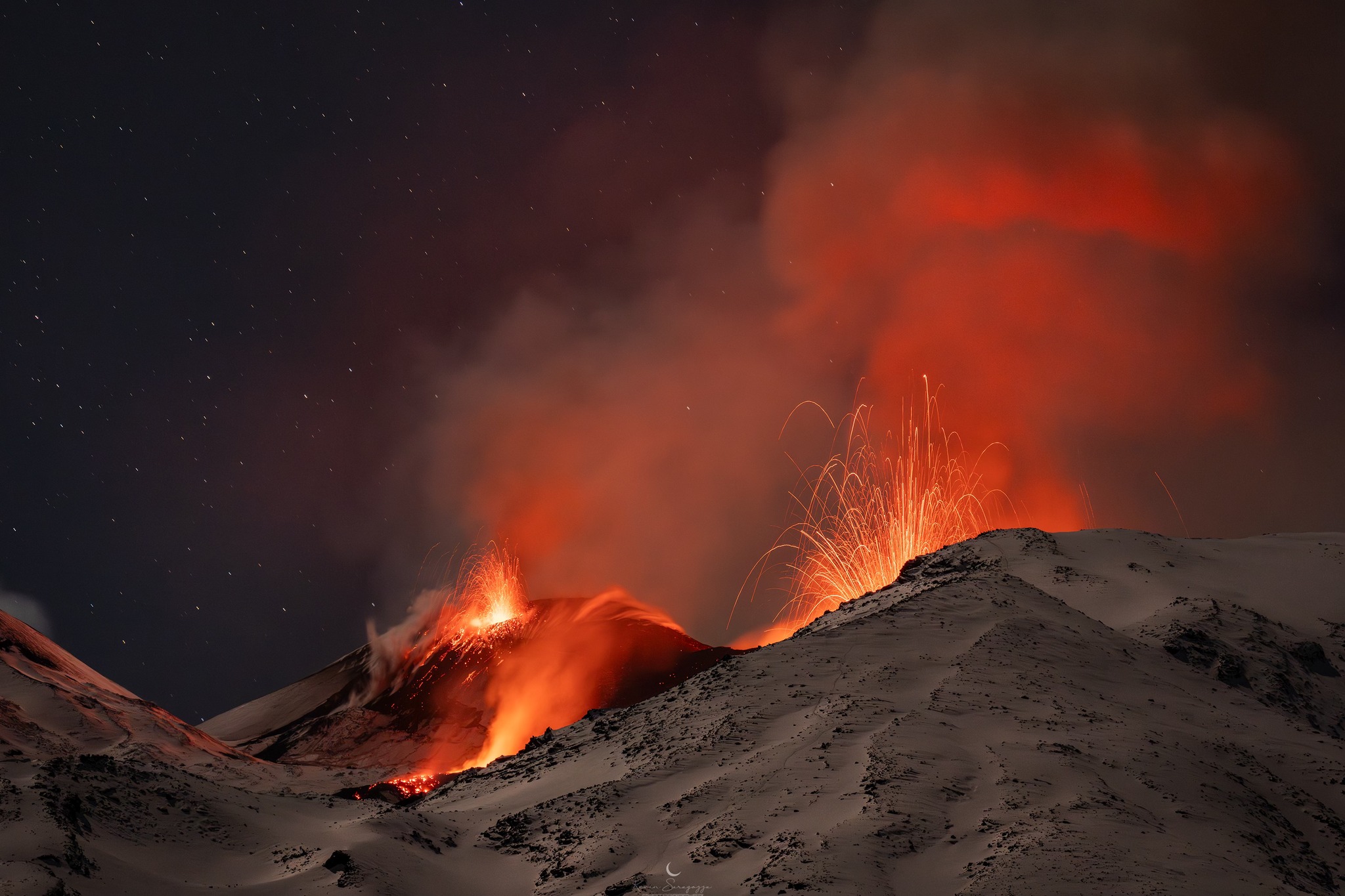
Formed in 1911 at the northeastern base of the then-central cone (which contained the Central Crater), the Northeast Crater experienced its first eruption in June 1917 with a lava fountain, followed by another the following year. In 1923, the volcano attempted for the first time to form a cone, which collapsed at the beginning of the 1928 eruption (the Mascali eruption). During the 1930s and 1940s, its activity was sporadic and less pronounced, but in 1947, it again produced a lava fountain, a prelude to the eruption later that year on the Northeast Rift.
From the mid-1950s, it exhibited almost constant Strombolian activity, accompanied by small lava flows, which led volcanologists of the time—notably Alfred Rittmann—to coin the term « persistent Strombolian activity. » At the end of 1970, during the longest cycle of this type of activity (1966–1971), the Northeast Rift reached the height of the Voragine cone, which had since stabilized within the former central crater. After another phase of sustained activity, marked by the opening of subterminal eruptive vents near Punta Lucia (1975–1977), the Northeast Crater’s activity changed. On July 16, 1977, fountains and lava flows began to form, rapidly spreading north and northwest: this was the first paroxysm in the northeast in 30 years. Others followed in August, November, and December, then in January and March 1978, for a total of about twenty paroxysms. The Northeast Crater thus introduced « explosive paroxysms » into Etna’s repertoire, a type of activity considered exceptional by volcanologists at the time. We now know that this type of activity has become the most typical of Etna.
Shortly after the last paroxysm of the 1977-1978 series, the Southeast Crater took over and has since produced hundreds of paroxysms. The Northeast calmed down somewhat, with three paroxysms in September 1980 and a fourth in February 1981 (a prelude to the Randazzo eruption in March 1981). It awoke again in September 1986, first with about ten days of Strombolian activity, then with one of the most powerful paroxysms of the last century, on September 24, 1986.
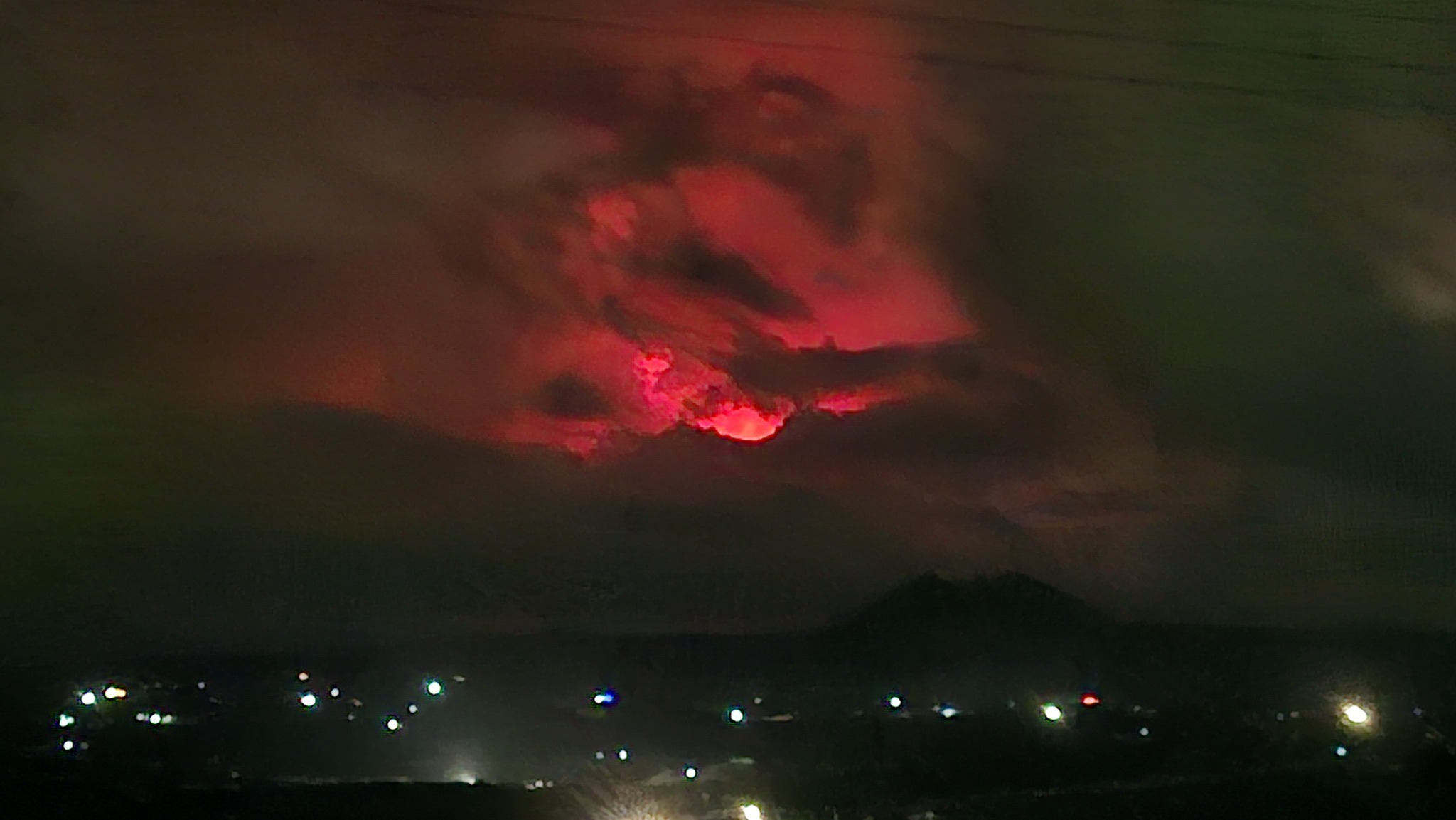
The photo shows lightning in the clouds on December 25, 2025, as seen from the countryside near Bronte.
Nine years passed. In July 1995, the Northeast Crater awoke with intra-crater Strombolian activity. Then, between November 1995 and June 1996, it produced another series of 10 paroxysms, some of them very violent and spectacular, such as the one on December 23, 1995. This period was followed, in July-August 1996, by a phase of Strombolian activity with three lava flows, one of which spilled into the nearby Voragine Crater (without, however, closing its open conduit).
A final isolated paroxysm occurred in the Northeast Crater on the night of March 27-28, 1998. Since then, several phases of intra-crater Strombolian activity have been observed, notably during the summer of 2002 (prelude to the 2002-2003 eruption), in May 2016 (shortly before a series of paroxysms at the nearby Voragine crater), in 2018-2019, and in 2020-2021. Finally, the Northeast Crater exhibited explosive activity during and after the series of paroxysms at Voragine in July-August 2024. In recent months, it has been characterized by intense lightning in its conduit, a phenomenon that has gradually intensified up to the events of the last few days.
Sources : INGV , Boris Behncke.
Photos : Salvatore Lo Giudice , Dario Lo Scavo , Guide Alpine Vulcanologiche Etna , Kevin Saragozza , Jenny Morella , Kevin Saragozza , Boris Behncke.