December 16 , 2025.
Alaska , Shishaldin :
Shishaldin Volcano continues to experience unrest, with occasional small earthquakes occurring over the past 24 hours. Webcam images showed a small steam plume at the summit. Infrasound signals, normally present, have been obscured by high winds. These winds have generated clouds of resuspended ash and dust that extend offshore to the south from several areas on Unimak Island, where Shishaldin Volcano is located. No signs of volcanic activity were observed in satellite imagery.

Shishaldin Volcano viewed from the summit of Roundtop Mountain on August 22, 2025. A steam and gas plume is visible drifting to the south in the image.
Local seismic and infrasound sensors, web cameras, and a geodetic network are used to monitor Shishaldin Volcano. In addition to the local monitoring network, AVO uses nearby geophysical networks, regional infrasound and lighting data, and satellite images to detect eruptions.
Source : AVO.
Photo : Loewen, Matt.
Iceland , Reykjanes Peninsula :
A minor earthquake was recorded along the Reykjanes Ridge early this morning, occurring at 7:38am local time, according to preliminary data from the authorities.
As reported by RÚV, the quake measured 3.2 in magnitude following later review and was located approximately 11 kilometres southwest of Eldeyjarboði, a small skerry off the Reykjanes Peninsula.
The event took place offshore and was not expected to have caused damage on land.

Seismic activity along the Reykjanes Ridge is closely monitored due to its connection with the wider Reykjanes volcanic system, which has experienced heightened activity in recent years.
Earthquakes in this area are relatively common and are typically associated with movements along the Mid-Atlantic Ridge, where the Eurasian and North American tectonic plates diverge.
There were no immediate reports of the earthquake being widely felt in nearby communities on the Reykjanes Peninsula, including Keflavík or the capital region. Authorities have not issued any warnings or alerts in response to the event.
Source : Icelandrewiew
Photo : Bar Harel. Wikimedia.
Colombia , Galeras :
San Juan de Pasto, December 9, 2025, 2:25 PM
Regarding the monitoring of activity at the Galeras volcano, the Colombian Geological Survey (SGC), an agency under the Ministry of Mines and Energy, reports the following:
During the week of December 2-8, 2025, the main variations in monitored parameters compared to the previous week were as follows:
● A slight increase in the frequency and energy of seismic activity was recorded.
Seismicity associated with fracturing of the volcanic edifice’s rock remains predominant.
● Seismicity was diffuse throughout the volcanic edifice, with depths reaching up to 10 km and a maximum magnitude of 0.9.
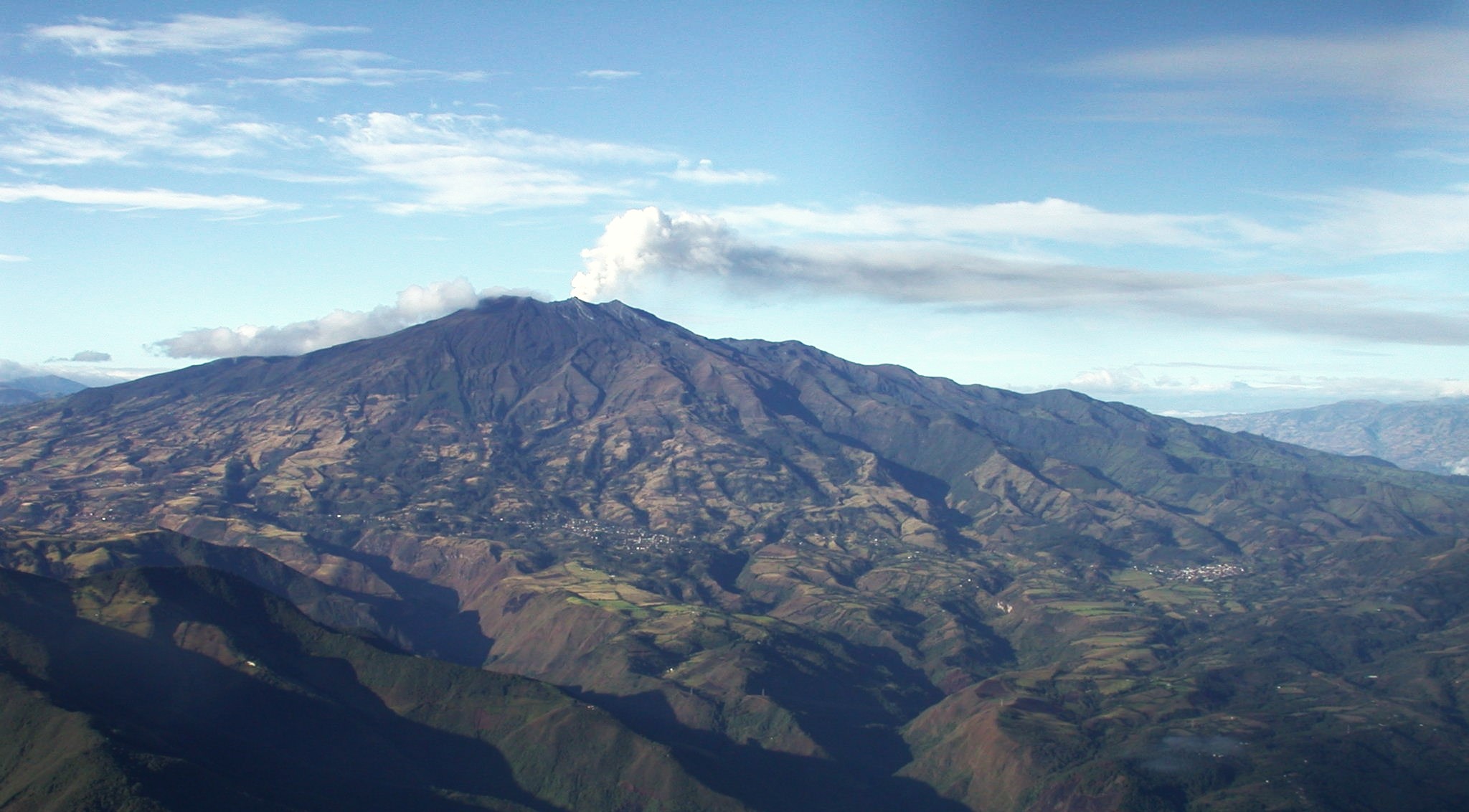
● Small plumes of white gas have been observed, mainly originating from the fumarole fields of El Paisita (North) and Las Chavas (West).
The other parameters of the volcanic monitoring system remained stable.
Given the above, the Geological Survey of Colombia (SGC) recommends closely monitoring the evolving situation by consulting the weekly bulletins and other information published through its official channels, as well as the instructions of local and departmental authorities and the National Unit for Disaster Risk Management (UNGRD).
Volcanic activity remains at the yellow alert level: active volcano exhibiting changes in the baseline behavior of monitored parameters and other manifestations.
Source et photo : SGC
Peru , Sabancaya :
Local date and time: December 15, 2025 – 12:09 PM
Bulletin analysis period: December 8-14, 2025
Volcanic alert level: ORANGE alert level:
The volcano’s eruptive activity has increased significantly. Increased seismic activity, frequent explosions, and emissions of ash and ballistic fragments have been observed.
Conclusions:
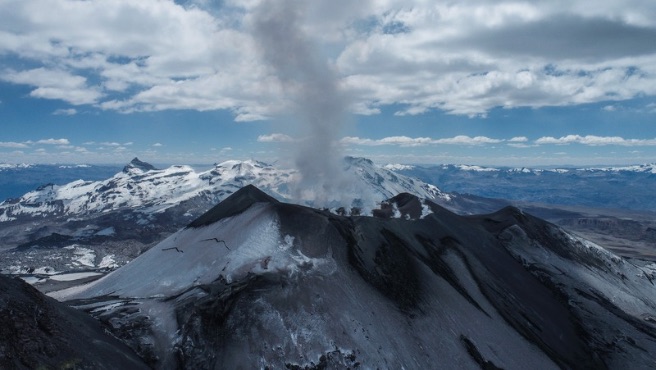
The IGP (Geophysical Institute of Peru) reports that the Sabancaya volcano continues its eruptive process. During this period, no volcanic explosions were recorded; however, emissions of water vapor, gas, and ash were observed, reaching a maximum altitude of 1,200 meters above the volcano’s summit. Seismic activity associated with the movement of magmatic fluids and internal fracturing was also observed. Consequently, the volcanic alert level remains orange.
Recommendations:
Take preventative measures in accordance with the current orange volcanic alert level.
Do not approach within 12 km of the crater. In case of ashfall, cover your nose and mouth with damp cloths or a mask. Keep doors and windows closed.
Outlook:
The occurrence of future volcanic explosions generating eruptive columns more than 2 km high is considered likely, with a risk of impact on districts in the Colca Valley and surrounding areas due to the dispersal of volcanic ash. Therefore, the volcanic alert level remains orange.
Source : Cenvul.
Photo : IGP.
Mexico , Popocatepetl :
November 2025 Activity Summary
Compared to October, November saw a decrease in tremor, long-period (LP) earthquakes, and volcano-tectonic (VT) earthquakes. This month also recorded the lowest tremor activity of the year. Several exhalations were also recorded, along with sequences of low-intensity exhalations accompanied by small amounts of ash and, occasionally, ballistic projections landing near the crater, which generally generated a low-amplitude seismic signal.
Throughout the month, analysis of satellite imagery consistently detected a thermal anomaly at the bottom of the inner crater, linked to the presence of a small lava flow.
Diagnosis
Based on the parameters assessed and the characteristics of recent activity, it is possible to conclude that the volcanic activity is due to a magmatic input, probably of small volume, resulting in the emplacement and recurrent destruction of small lava flows. Overall, no substantial changes have been observed compared to October; the activity can therefore be considered stable.

Forecast
Based on the above, and in the most likely scenario, no significant changes are expected in the coming days or weeks compared to previous months. Activity could manifest as episodes of harmonic and high-frequency tremors of varying amplitude, possibly low amplitude, as has been observed several times in recent months. A few volcano-tectonic earthquakes, low- to medium-amplitude LP events, sporadic explosions, and small to medium-sized exhalations with ash emissions are expected, possibly accompanied by ballistic projections not exceeding the 12-kilometer exclusion zone (mainly located near the crater). Thermal anomalies within the crater, similar to those reported here and associated with the formation of small lava bodies, could also be detected.
As the volcano’s activity level can change at any time, monitoring is carried out 24 hours a day, 365 days a year.
The most likely scenario, in the medium and long term, is that the current eruptive process, which began in 1994, will continue without exceeding the most significant episodes observed in June 1997, December 2000, January 2001, and those that occurred between 2012 and 2013.
Source et photo : Cenapred .