September 6 , 2026.
Indonesia , Ili Lewotolok :
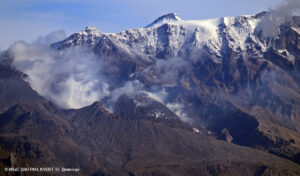
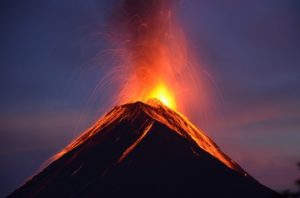
An eruption of Mount Ili Lewotolok occurred on Sunday, September 6, 2026, at 06:41 WITA; the observed ash column reached a height of approximately 600 m above the summit (or about 2,023 m above sea level). The dense, gray ash column drifted towards the southeast. The eruption was recorded by the seismograph with a maximum amplitude of 40 mm and a duration of 82 seconds.
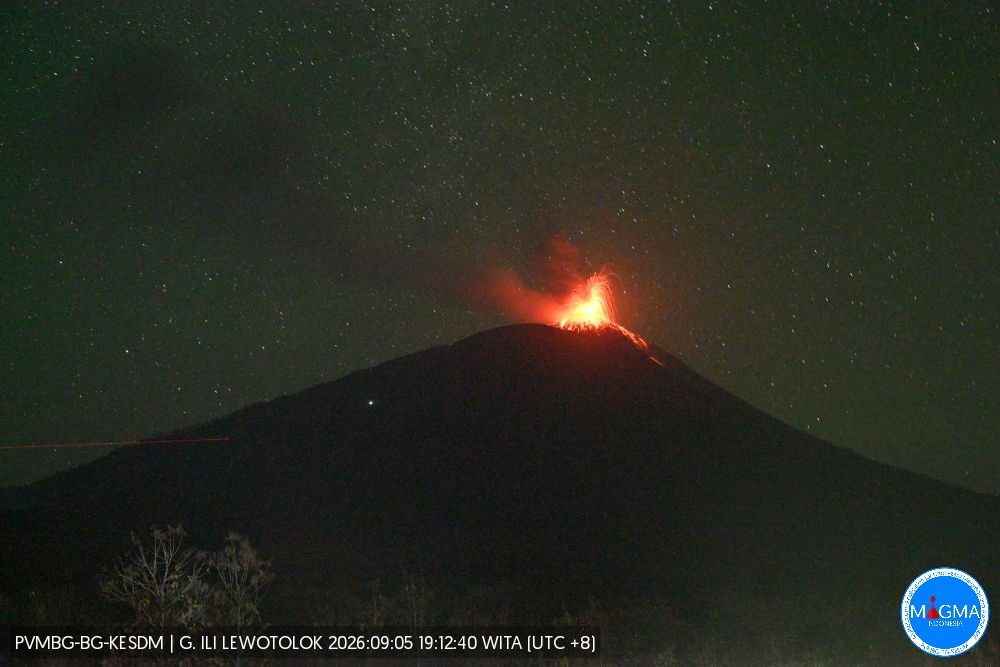
Seismic observations
311 eruption earthquakes: amplitudes of 11.1–40 mm, durations of 31–186 seconds.
218 emission earthquakes: amplitudes of 4.4–40 mm, durations of 20–74 seconds.
3 harmonic tremors: amplitudes of 5.5–40 mm, durations of 80–145 seconds.
40 non-harmonic tremors: amplitudes of 3.3–40 mm, durations of 88–346 seconds.
2 hybrid/multiphase earthquakes: amplitudes of 6.6–11.1 mm, durations of 12–21 seconds.
1 shallow volcanic earthquake: amplitude of 40 mm, duration of 14 seconds.
4 deep volcanic earthquakes: amplitudes of 11.1–40 mm, durations of 8–12 seconds.
1 distant tectonic earthquake: amplitude of 16.6 mm, duration of 86 seconds.
Recommendations
1. Communities living near Mount Ili Lewotolok, as well as visitors, climbers, and tourists, must not enter or conduct activities within a 2 km radius—extending to 3 km in the southern and southeastern sectors—of the Mount Ili Lewotolok activity center.
2. Remain vigilant regarding potential risks of lava avalanches/rockfalls and pyroclastic flows in the southern, southeastern, western, and northeastern sectors of Mount Ili Lewotolok.
Source et photo : PVMBG.
Hawaii , Kilauea :
HAWAIIAN VOLCANO OBSERVATORY DAILY UPDATE , U.S. Geological Survey
Saturday, September 5, 2026, 8:32 AM HST (Saturday, September 5, 2026, 18:32 UTC)
19°25’16 » N 155°17’13 » W,
Summit Elevation 4091 ft (1247 m)
Current Volcano Alert Level: ADVISORY
Current Aviation Color Code: YELLOW
Summary:
Kīlauea volcano is not erupting; the summit eruption in Halemaʻumaʻu is paused. Summit inflation remains stalled for the past 24 hours after a day of deflation. A forecast window of September 7-13 is likely for the next fountain episode.
Overview:
The summit eruption of Kīlauea in Halemaʻumaʻu is paused. Weak to moderate glow was nearly continuously visible overnight from the north vent. Summit reinflation has been very irregular since lava fountaining episode 54 on August 25. The deflation that began Thursday morning transitioned into a period of little or no change for the past 24 hours. The current pattern is similar to what followed the last few episodes. A forecast window of September 7-13 is likely for the next episode if inflation follows the prior patterns.
No significant activity has been noted along Kīlauea’s East Rift Zone or Southwest Rift Zone.
Summit Observations:
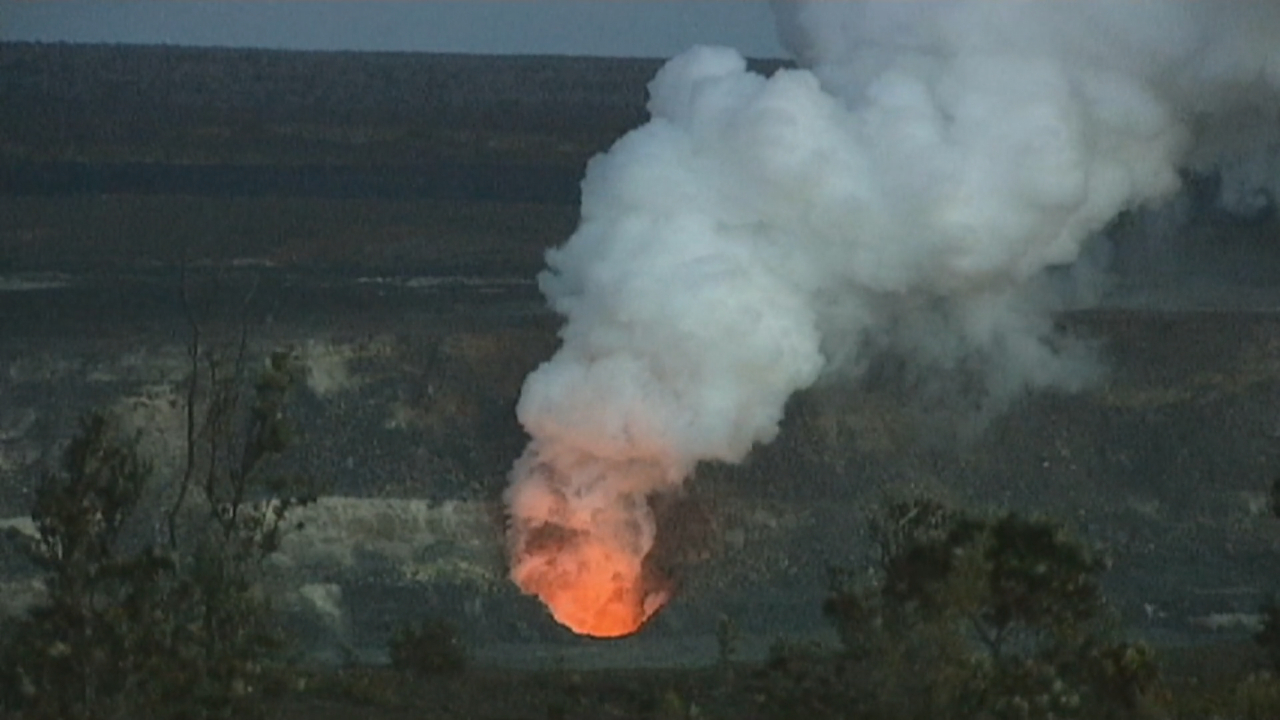
Overnight webcam views showed weak to moderate glow nearly continuously from the Halemaʻumaʻu north vent. The periodic flames and gas pistoning characteristic of the past few days were absent overnight and glow appears to be related to magma rising higher in the vent system.
Low level, continuous tremor is present across the summit. No significant tremor bursts were recorded by summit seismometers over the past 24 hours. No shallow earthquakes were recorded beneath the summit region over the past 24 hours.
Summit reinflation has been very unsteady since lava fountaining episode 54 on August 25. On Thursday, tilt recorded on UWD had declined from 7.8 to 6.2 microradians relative to the end of lava fountaining episode 54. Since yesterday morning, inflation remains stalled with the UWD tiltmeter reading 6 microradians. Deflationary tilt on UWD totaled 12.7 microradians during episode 54.
During inter-episode pauses, the sulfur dioxide (SO2) emission rate from the summit typically varies between 1,000 and 5,000 tonnes per day. Strong trade winds are pushing the degassing plume to the southwest over the Kaʻū Desert this morning.
Rift Zone Observations:
Rates of seismicity and ground deformation remain low in the East Rift Zone and Southwest Rift Zone. SO2 emissions from the East Rift Zone remain below the detection limit.
Source et photo : HVO.
Colombia , Nevado del Ruiz :
Manizales, September 1, 2026, 7:30 PM.
Based on monitoring of the Nevado del Ruiz volcano’s activity, the Colombian Geological Service (SGC)—an agency under the Ministry of Mines and Energy—reports the following information:
During the week of August 25 to 31, 2026, the volcano continued to exhibit unstable behavior.
Compared to the previous week, the main variations in monitored parameters were as follows:
– Seismic activity linked to rock-fracturing processes within the volcanic edifice decreased in terms of the number of recorded earthquakes and the seismic energy released. The earthquakes were located at the Arenas crater and, in a scattered manner, on various flanks of the volcano, within a 7 km radius of the crater and at depths ranging from less than 1 km to 8 km below the volcano’s summit. The maximum magnitude reached was 1.4, corresponding to the earthquake on August 25 at 6:52 PM, located 6 km east of the crater at a depth of 4 km.
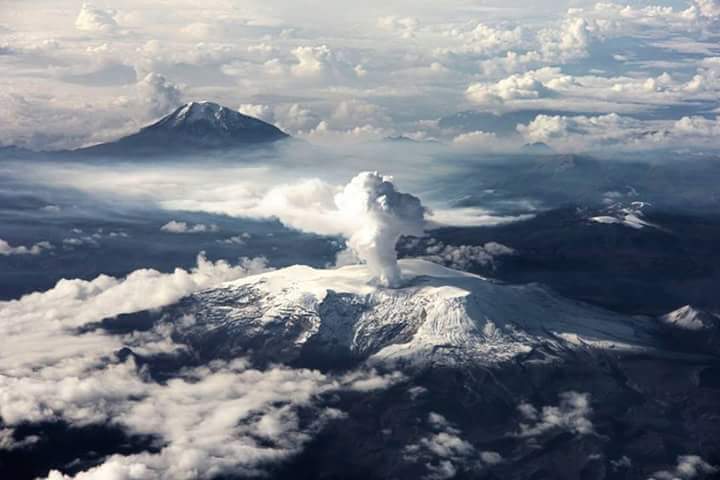
– Seismicity associated with fluid dynamics within the volcanic conduits showed a decrease in the number of events, while the levels of released seismic energy remained similar. This activity was characterized by short-duration, low-energy seismic signals. As in previous weeks, no long-duration seismic signals were recorded. Similarly, no ash emissions into the atmosphere were confirmed, and no changes in the apparent temperature of the gas column were observed.
– Emissions of water vapor and volcanic gases—primarily sulfur dioxide (SO₂)—into the atmosphere continued from the Arenas crater. Estimates of SO₂ flux associated with degassing processes showed levels similar to those of the previous week. Meanwhile, complementary satellite monitoring continued to indicate low levels of SO₂ output.
– The gas and water vapor plume maintained a vertical height of less than 300 m above the volcano’s summit, with a predominant dispersion direction towards the northwest flank.
For most of the week, observation of the plume was limited by heavy cloud cover in the area. Monitoring of thermal anomalies at the base of the Arenas crater via satellite platforms was also limited by atmospheric conditions in the area. No thermal anomalies were recorded during this period.
Source et photo : SGC.
Costa Rica , Rincon de la Vieja :
OVSICORI-UNA Weekly Volcanic Monitoring Bulletin, September 4, 2026
Latitude: 10.83° N;
Longitude: 85.34° W;
Elevation: 1,916 m above sea level.
Current activity level: Advisory.
Fifty-seven eruptions were recorded this week; ten of them reached an acoustic magnitude greater than 4. The eruption on August 31 at 16:38 exhibited the highest acoustic magnitude recorded since the beginning of the year. The August 31 eruption generated a syn-eruptive lahar (triggered directly by the eruption). The highest number of eruptions was recorded on September 2 and 3. Low-frequency background tremor (0.7–2.5 Hz) showed a gradual increase starting August 30, persisting until September 4. However, amplitude variations were observed throughout the week. Starting September 3, a sequence of low-frequency « banded tremors » was observed, with some associated with eruptions. During the phase of increasing tremor, a rise in the frequency of small eruptions was noted; conversely, when the amplitude decreased, higher-amplitude eruptive events were observed.
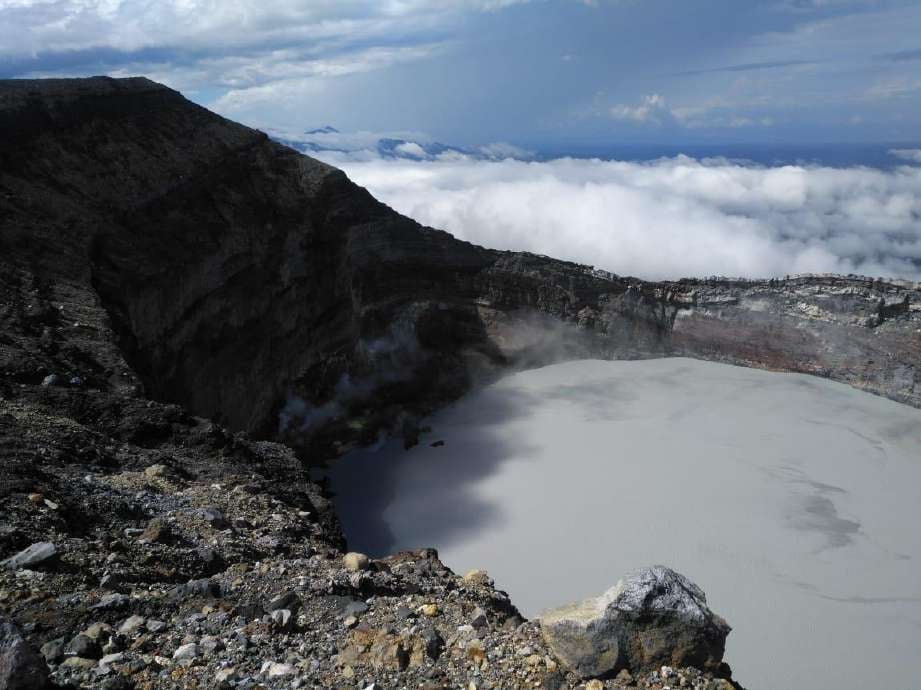
An increase in long-period events was noted on September 3, alongside a rise in volcano-tectonic events in the immediate vicinity of the volcano on August 29 and 30. Following the eruption at 04:16, low-frequency tremor decreased; this could suggest an accumulation of volcanic fluids capable of triggering a moderate-magnitude eruption. No significant short-term (1–2 month) deformation has been observed, although summit expansion was recorded in June. Over the medium term (6 months), subsidence of the volcanic edifice has been noted. The average SO2 flux for the week was 330 ± 90 t/d, with a peak value of 3,967 t/d. These figures indicate a decrease in SO2 emissions compared to the previous week, when the average flux was 590 ± 284 t/d with a peak of 4,912 t/d. Despite this decrease relative to the previous week, the values remain above the volcano’s baseline level.
Source : Ovsicori.
Photo : Waldo Taylor de ICE.
Ecuador , El Reventador :
DAILY STATUS REPORT FOR REVENTADOR VOLCANO, Saturday, September 5, 2026.
Information from the Geophysical Institute – EPN.
Surface activity level: High; Surface trend: Unchanged
Internal activity level: Moderate; Internal trend: Unchanged
From September 4, 2026, 11:00 to September 5, 2026, 11:00:
Seismicity:
Explosion (EXP): 78
Long-period (LP): 11
Emission tremor (TREMI): 7
Harmonic tremor (TRARM): 5
Precipitation / Lahars:
No precipitation has been recorded in the area. **Heavy rains could remobilize accumulated material and generate debris-laden mudflows (lahars) capable of descending the volcano’s flanks and flowing into adjacent rivers.**
Ash emission/plume:
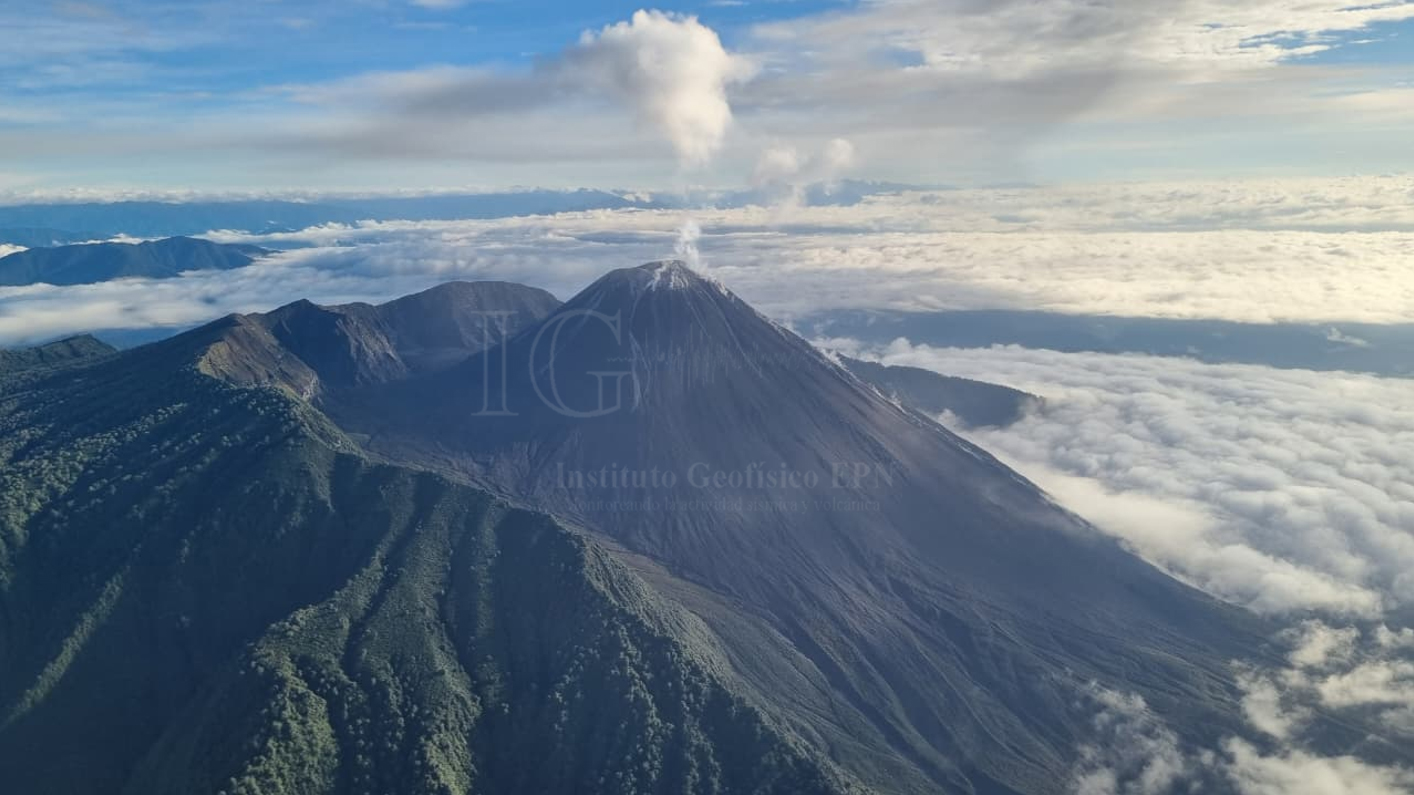
Since yesterday afternoon, the surveillance camera network has observed several gas and ash plumes drifting west and southwest, reaching altitudes of 300 to 800 meters above the crater rim. In connection with this activity, the Washington VAAC issued a report noting an ash cloud rising 700 meters above the crater rim and drifting westward.
Observation:
Overnight and during the early morning hours, the surveillance camera system recorded several episodes of incandescent material descending the volcano’s flanks to a point 1,000 meters below the crater rim. At the time this report was finalized, the volcano was visible and free of cloud cover.
Alert Level – SGR: Orange
Source et photo : IGEPN.